How to Make a Jojo Inspired Background How to Make a Jojo Inspired Art
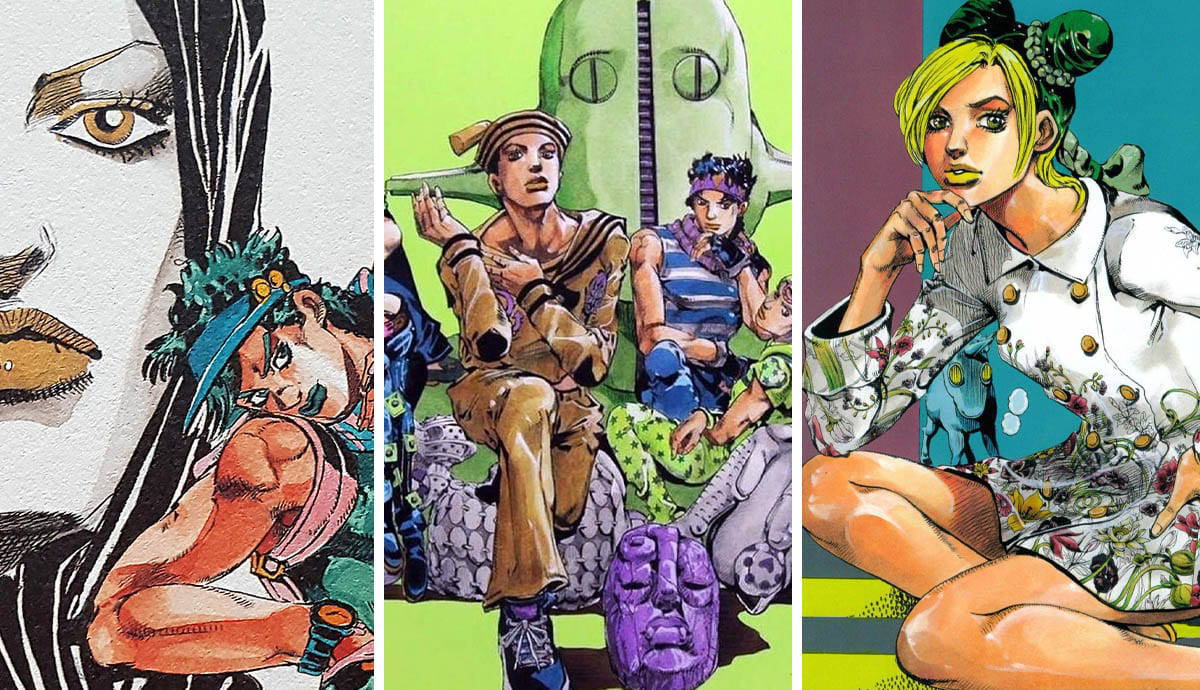
The works of Hirohiko Araki bridge decades simply there is one matter that has remained consistent upon the honing of his craft, his references to popular civilization, art, and way. This manga creator, this illustrator, this designer sought to bring something different to the medium, and in doing so Araki created a brand that is unforgettable and eccentric. His references are and so versatile then hit that his work culminates into something that has been revered as high art by many and loved every bit a pop-culture miracle.
What Is Manga?

In that location are a lot of misconceptions as to what manga really is, with definitions varying from black and white comics, to strictly Japanese comics, to fifty-fifty a specific style. The closest definition includes any printed animated media within Nippon. Manga was not established as a kind of overarching style until the "Godfather of Manga," Osamu Tezuka , developed new techniques and redefined already established genres with works such as Astro Boy and Jungle Emperor Leo in the 1960s.
Almost people outside of Japan, and many inside, go by the latter definition and believe manga to be a grade of media that you know when yous come across. Nowadays, mangakas, or manga artists, take so many varying styles that information technology would be ignorant to endeavour to define manga strictly by some of its more known stereotypes, like big optics, spiky pilus, and crazy proportions. There are manga that practise indeed still find appeal in all iii attributes, in some way, but using these equally a basis every bit to what manga is would be discrediting artists like Takehiko Inoue , Shinichi Sakamoto , and, of class, Hirohiko Araki.
Who Is Manga Artist Hirohiko Araki?

Hirohiko Araki is a manga artist in Nihon best known for his ongoing work and magnum opus, Jojo's Bizarre Adventure , which began publishing in 1986 but debuted in the early 1980s . He takes inspiration from classical techniques in paintings and sculptures, the color manipulation of Paul Gauguin, Western pop culture, and manner to create an engaging globe and characters.
Are you enjoying this article?
Sign upwardly to our Free Weekly Newsletter
Please cheque your inbox to activate your subscription
Thank you!
He was born in Sendai, Nihon on June 7th, 1960, and drew his first manga when he was only in the 4th course. Later an interaction with a friend, who complimented his work back and so, he idea that taking on manga as a future career was an option to look into. In the 60s striving to get a manga artist was something that people looked down upon, as it was not a conventional career path. So, Hirohiko Araki prepare most practicing his art behind his parents' backs and eventually submitted his first work during high school — it was soundly rejected along with many other submissions. Somewhen, he received recognition for his Poker Under Arms every bit a runner-up to a manga competition known as the Tezuka Awards.

Despite making his debut Hirohiko Araki knew that he needed to create a style that was unique and distinctive if he wanted to truly stand out in the industry. Poker Under Arms ' fashion is very indicative of the 1980s lacking the overarching uniqueness he hoped to achieve afterward. Afterwards the early advent of manga as a style, there was something akin to an manufacture standard for how certain genres and works within certain publications had to look. So, it was not out of the ordinary to view works that had eerily similar styles; Hirohiko Araki's decision to co-operative out style-wise was a smart one, as his piece of work could have been lost in a sea of uninventive works regardless of the story his art told.
Influences From Paul Gauguin

Paul Gauguin was a French creative person best known for his Post-Impressionist works and his help in pioneering the Primitive mode . After the formulation of his The Vision afterward the Sermon (Jacob wrestling with the Affections) in 1888, Gauguin alleged himself a Synthetist. Synthetism was known for its flat areas of color and bold outlines which tin exist seen throughout Hirohiko Araki'south later works. During a lecture , Araki stated that he was fond of Paul Gauguin since he was a kid and eventually used Gauguin's Impressionist and Mail-Impressionist pieces as inspirations for his later work. What inspired Araki the nigh most Gauguin's work was the apply of color-blocking and the lively use of unrealistic colour. He appreciated the idea that the ground [could exist] pinkish and the trees [could be] blue.
Where Can Gauguin's Influences Be Seen?

The improve question is: Where can't it exist seen? But take the prototype to a higher place as i instance. This painting was done for Hirohiko Araki's most recent Jojo Exhibition, and in this piece of work, you lot can see some basic influences from Synthetism and Gauguin's works. To compare, permit's talk about Gauguin'due south previously mentioned work — The Vision of the Sermon (Jacob wrestling with the Affections). On the surface, it seems similar at that place isn't much of a comparison, but upon really looking at the two for its strictly technical aspects it all begins to fall into identify.

Hirohiko Araki mimics Gauguin's employ of non just a large expanse of flat color merely also maintains a very limited palette much like The Vision after the Sermon . Araki also contrasts warm and cold against ane another to brand the subjects of the piece pop. Furthermore, in that location is a curving structure in both pieces created by the people, while Araki chooses to put this curving grouping of characters in the groundwork Gauguin puts them forepart and eye. Additionally, to break upwardly the piece and assure that the flat colour is not too overwhelming they both employ similar methods.
Gauguin places a tree moving diagonally through the shot to create dissimilarity and perspective. Araki applies a like method by interspersing green strokes of what looks to be grass throughout in an endeavor to intermission upwards the orange and create a sense of distance and a line between the ground and the sky.
Renaissance Sculpture: Michelangelo Buonarotti

Hirohiko Araki himself has stated that his main influence for the overarching advent of the characters he works on themselves comes from ii main places. Fist of the N Star past Tetsuo Hara is an 80s anime that came out three years before the release of Jojo'south Bizarre Run a risk in Weekly Shonen Leap . Fist of the North Star is a power fantasy manga that is adorned with big, well-muscled, hyper-masculine physiques. Araki absolutely has a run of anatomy, and much of how he draws his characters comes from not just the sinew and muscle of Fist of the North Star but also the sculptural works of Michelangelo di Lodovico Buonarroti Simoni .
Upon viewing a time-lapse video of how Araki created the above painting, there were many aspects of his process that stuck out but what is well-nigh fascinating is his reference cloth. He used magazines, his own hand-fatigued reference materials, and an artbook called Michelangelo: Complete Works past Lutz Heusinger.

For case: In the video, Hirohiko Araki used Michelangelo's Genius of Victory for the summit left male figure; Two Wrestlers for the second figure to the left; and Crouching Youth as a reference for the bottom right white effigy.
By using these references he was able to achieve authentic and platonic proportions due to Michelangelo'due south studies of the body and by incorporating other exterior influences such as fashion photoshoots and fashion illustrations. Araki'south versatile references and inspirations are what immune him to c reate a fashion that is uniquely his own.
Hirohiko Araki's Honey Of Fashion

Hirohiko Araki's piece of work is not just stylistically unique, it'south alive in almost every aspect. About of his work has a foundation in reality despite how otherworldly it can seem at times. The overall liveliness of the works in which he creates comes from using culturally relevant reference materials as well equally the ones mentioned prior. It is Araki's appreciation for fashion that allows his work to be as realistic and well… fun as it is.
In interviews, and even with just analyzing his work from the 80s one tin can find his beloved for Versace, Moschino, and his heavy usage of Faddy mag photoshoots. High manner models' poses tend to have unrealistic, otherworldly, and even awkward poses, notwithstanding they still maintain the natural gestures necessary to incorporate them in Araki'southward work. High manner poses lack that day to twenty-four hour period feel of candid poses which allows Araki's images to pop in the way that they do.

In 2013, GUCCI asked to collaborate with Araki on their bound fashion drove and it was called GUCCI 10 JOJO . All over the world, GUCCI shops were displaying illustrations of some of his near beloved characters from across Jojo's brand. Similar the images above, Jojo's characters were adorned in GUCCI from head to toe, sporting: article of clothing, numberless, and shoes, advertising the looks of the season.
Every bit an aside, that February, Araki'south one-shot manga Jolyne, Fly High with GUCCI was published to Spur , a Japanese way magazine for women, where the main character sported wear from Frida Giannini's 2013 Cruise Collection and did the window advertizing illustrations for the storefronts as well. It is easy to say that Araki's love of fashion is what led him to opportunities such every bit this, and it was inevitable that the world saw these collaborations on the scale that they did.
The Impact Of Fashion Illustrations By Tony Viramontes

Hirohiko Araki did not just take inspiration from the clothing and models themselves merely also their illustrations. Araki uses the works of many simply i of the artists referenced the most was Tony Viramontes . Tony Viramontes was a fashion illustrator that took the 70s and 80s by tempest working with the likes of Versace, Chanel, Valentino, Paloma Picasso and worked with photographers employed by Vogue . His work lacked the traditional outlook on manner analogy, information technology had punch, it had attitude and bold lines and color that was not typically seen. He used abstraction to its limit taking the educational activity from his mentor Antonio Lopez and stretching them to the max until they were almost unrecognizable.
His more archetype piece of work An Ideal Adult female, from early in his career holds similar principles to Synthetism with its potent apply of flat colour and accents of some thick white outline in the scarf, giving Araki quite the inspiration for his cover art. Araki juxtaposes his more classic design on the smaller character to the correct of the main figure with those blocks of white and heavy white lines on the scarf, taking from both Viramontes in the overarching idea and Gauguin in his use of unrealistic yet strong color.
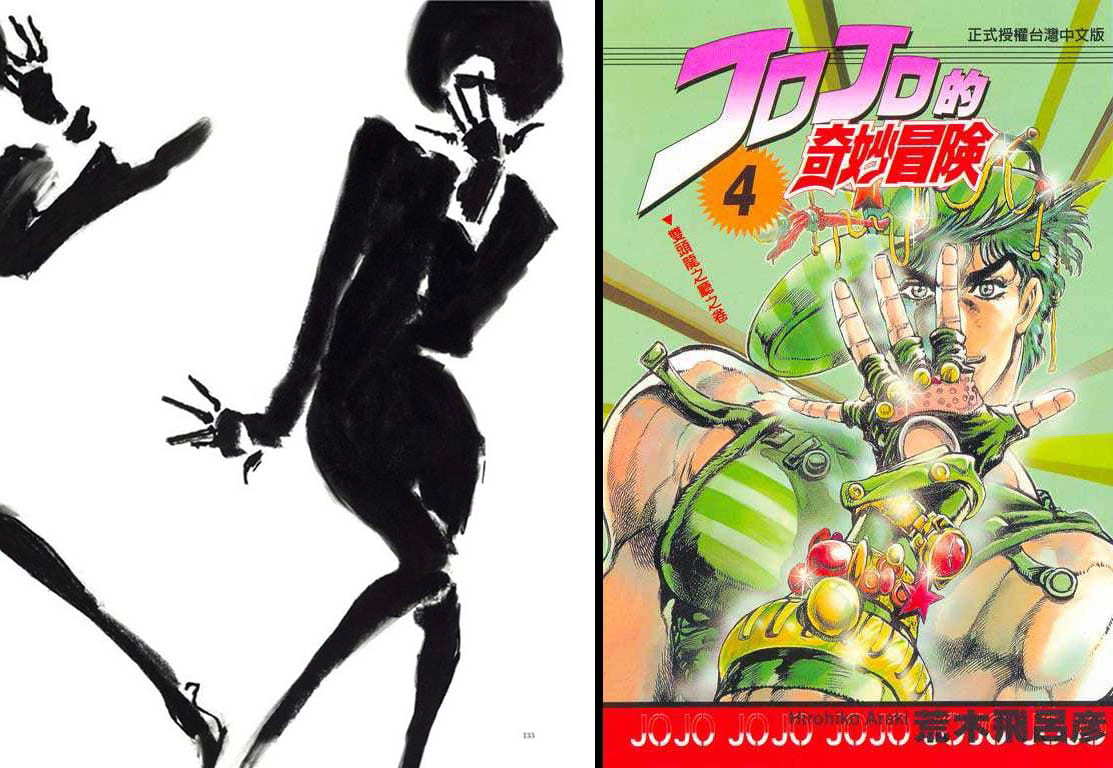
Hirohiko Araki used Viramontes' later works in the same mode that he used fashion magazines. Viramontes was known for getting the models in interesting and anarchistic poses, then they were perfect for Jojo'south Bizarre Hazard . Araki was able to incorporate Viramontes' gestures in masterful ways, bringing Viramontes' work out into a new light.
Antonio Lopez's Influence On Hirohiko Araki

Antonio Lopez'southward fashion illustrations as well greatly inspired the works of Hirohiko Araki due to the chichi nature of his works and how fashion-forward they were. He and his collaborator Juan Ramos were the arbiters of new and innovative design from the 60s to the 80s, helping to bring in a new era of style. Most of what Araki used Lopez'due south illustrations for were their overall poses and fashion, not necessarily color or style similar he did with Tony Viramontes. His illustrations would be seen in Faddy and the Times allowing Araki to apply his work equally inspiration for some of his most iconic covers for the fourth dimension. His illustrations were known throughout the world of fashion, from Paris to Tokyo to New York, his illustrations were extremely recognizable if you were a fashion lover of the times.
The title page to a higher place was during Araki's more than formative years in terms of mode, so it lacked the extreme apply of color and bold lines. Yet the manga artist was able to seamlessly incorporate Lopez'due south design with his style and a few changes of his own to create a pose that many who find Jojo beloved to them would not soon forget.

Post a Comment for "How to Make a Jojo Inspired Background How to Make a Jojo Inspired Art"