Lyrics I Always Thought I Would See Again

James Taylor and Carole Male monarch, who played piano on 'Fire And Rain'. Keystone/Getty Images hide caption
toggle explanation
Keystone/Getty Images
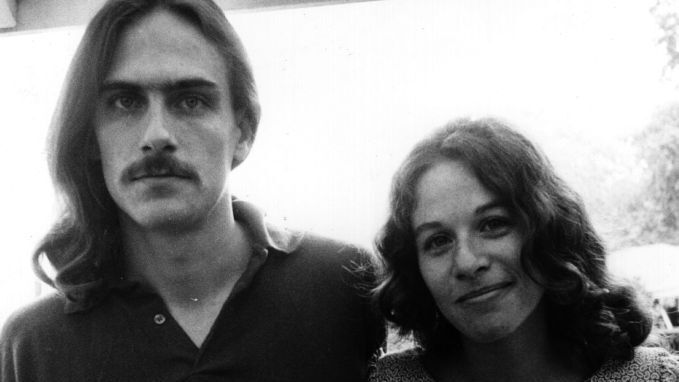
James Taylor and Carole King, who played pianoforte on 'Burn down And Rain'.
Keystone/Getty Images
James Taylor now has a happy grinning, and at 52, he is tall, thin and mostly relieved of hair. In the old pictures from the '70s, he has long black hair and a somber, gaunt expression. His voice hasn't changed. Even in the saddest songs, information technology's always had a kindly nature to it. He was born in New England and raised in North Carolina, and you can hear the influence of both regions.
NPR 100 Fact Sheet
Title: Fire and Rain
Creative person: Words/music James Taylor
As performed by James Taylor
Reporter: Noah Adams
Producer:
Editor:
Length: 12:thirty
Interviewees: James Taylor
Recordings Used: Fire and Pelting, James Taylor
Taylor wrote "Burn down and Rain" in 1968. The song has three verses. 1 is most a friend who committed suicide, some other is about Taylor's addiction to heroin, the 3rd refers to a mental hospital and a band Taylor started chosen The Flight Automobile. Each poetry is followed by the same chorus, `I've seen burn down and I've seen rain. I've seen sunny days that I thought would never end. I've seen lonely times when I could non find a friend, simply I always thought that I'd see you lot again.' James Taylor told me he tin can't stand to hear his songs on the radio. He dives for the punch if "Fire and Rain" comes on. But information technology remains a song he likes to sing and ane that audiences always wait for.
"I tried to effigy out at one signal how many times I'd sung information technology," Taylor says, "and I think it's probably approaching a 1000 times now. I sung it yesterday at lunchtime for a benefit, and that may accept been the thousandth time. For a while I thought it would exist squeamish to build an odometer, like a big odometer that was visible on stage that had a big plate on the top of information technology that one struck with a mallet, you know, and--that every night we'd gear up it back to 999 and then turn it over to the ritual thousandth singing of 'Fire and Rain,' and then strike it with the mallet to drive it home."
Later such a long run, information technology'due south understandable that "Fire and Rain" could flatten out emotionally for Taylor afterwards all these years. Only his fans' reactions to the song keep to surprise him.
"I'thousand surprised actually at how durable it is or how reliable the connectedness--the emotional connexion it makes is," Taylor explains. "But does information technology ever go apartment for me? Yes. Yes, it has. And the way--if I'm distracted or overwhelmed, I tin can forget where I am. I mean, in that location'due south a song with iii verses with the same form and three choruses post-obit them. There's no bridge, in that location's no release, no suspension. So I can forget where I am. It'due south a terrifying matter, and it doesn't happen oftentimes, just it does, as they say, concentrate the mind."
"You want to feel as though you lot're making a connection with it. It helps to have an audience at that place receiving it, because then you want it to happen for them, also. It'southward, like, but a common--you know, making music for an audience is a communal process. And and then, you know, they're resonating with it, I catch that, also. That's contagious."
Each of "Burn down and Pelting"'due south verses deals with an adversity Taylor has dealt with in his life. The first is well-nigh a friend, Susanne, who he found had died,
"At the time, I was recording in England with The Beatles, and my friends had sort of kept the information well-nigh this death from me because they thought, yous know, `This is a crucial time for him, he's doing his work, and we don't desire to upset him or bring him down.' So my friend Richard Corey told me nearly it, simply he had known most it for a month or so earlier he mentioned information technology to me. Then that's where `they permit me know you were gone' comes in."
The second poetry is when you're all the same struggling to get off hard drugs,
"That was in New York, and that was when I came back to this country from London and was surprised that I'd picked up a habit. And so I was physically very uncomfortable and having a crude time."
And the third verse in the mental hospital at Stockbridge.
"Up at Austin Riggs in Stockbridge. Yep. It was--that is not a very--that's not so much a specific one, it's just sort of--I don't know what--kind of generally introspective kind of verse, I guess."
Taylor notes that if "Fire and Rain" were prose rather than poetry, it might be more than open and explicated and described and have less of a connection with people. For Taylor, it's non about the actual data of the song, but the emotional connection with that information.
"Y'all know, when someone understates something completely, you know, like a song like "What'll I Do?" you know, `What'll I do when you are far away and I am blueish? What'll I do?' you lot know, when it'southward minimally stated, information technology but becomes pure emotional, you know? It's--information technology near makes you laugh the way it makes you weep, you lot know, because information technology'south and so directly stated that it'southward about like it punches a hole in you lot. It, like, lets information technology out of a identify where it doesn't usually come up out of, you know. Some haikus are like that. You read them and it's sort of similar it's almost funny how direct people are being, you know? "
Surprisingly for a song with equally deep every bit "Fire and Pelting," the songwriting process was elementary for Taylor, who says its creation was almost therapeutic.
"It does come very quickly," Taylor explains. "It did come very, very fast. But it was a corking relief. That song relieved a lot of sort of tension. There was things that I needed to get rid of or at to the lowest degree go out of me or arrive front of me or at least have some other relationship than feeling them internally, either by telling somebody else or by but putting them out in a form in front of me and then that I could say, `There they are,' yous know, externalizing it somehow. And that part was hard, having the feelings that needed to be expressed in that way. Simply it was actually a relief, like a express joy or a sigh.
But these days, the songs don't come as hands.
"They come less frequently and perchance I don't have the same urgency to become them out. It'southward however a delight to write something and I still love information technology, simply I recall a couple of things have inverse. One is that I'thou older and that I'm not equally emotionally intense. I've found other solutions--emotional solutions in my life. Another affair is that I'thou more distracted. It's but very difficult for me. I recollect songs need to come out of--really out of a state of boredom almost as much as annihilation else. Y'all demand to have empty time in society to receive them. I'g much more distracted now and there's less fourth dimension for them to come through. And I think the other matter is that in that location is a alter between feeling the demand to express something from the inside out and beingness enlightened of yourself in the marketplace and feeling as if the songs are somewhat beingness pulled out of y'all as something that'south expected of you. And then I've go more enlightened of it as something that I'm expected to do. And, you know, at the time that I wrote that song, I really didn't anticipate that anyone would hear it, yous know? I mean, the motivation for writing information technology was quite pure. And that'southward not the case so much anymore."
Source: https://www.npr.org/2000/06/26/1075908/npr-100-fire-and-rain

Post a Comment for "Lyrics I Always Thought I Would See Again"